
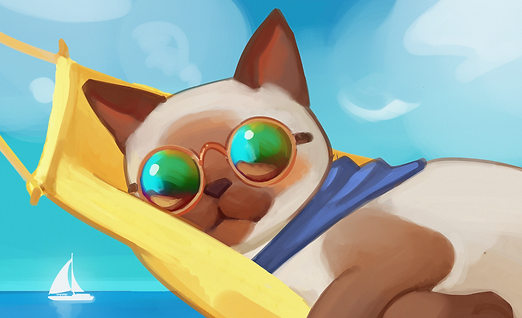
A day with Mochi is my end of studies project. It is sandbox open world game where the player plays as Mochi, a young cat who wants to wreck mayhem in a postcard town on an island of the Caribbeans.
I worked full-time on this project as Game Designer during all of my fifth year of studies.
The game was presented during our end of studies jury the 23rd of June 2023.
Watch the trailer here.
During the first months of pre-production, our goal was to setup the foundations of our systems (AI and objects), controller, Level Design and Artistic Direction.
In pre-production, the bulk of my work was to design the behavior foundations of the AIs and objects the player can interact with. This took many forms:
-
Collective brainstorms, to collect as much ideas as possible from the team and to see how the creative vision of the game was understood by every team member.
-
Writing of game sequences based on our gameplay intentions to find patterns in the behaviors we want.
-
Writing of a global game design documentation on Notion in collaboration with the other designers to have a complete picture of our objective and put "on paper" the system sesign.
-
Prototyping interactive objects and setup of AI via blueprints on Unreal Engine 5 for our prototypes.

This version of the game affirmed our intentions for AI behaviors, but showed that our objects interactions were too bland, not diverse enough, and did not offer much room for experimentation. We made the choice to rework our objects systems to have much more design flexibility and allow interactions with more exponential chaos potential.
Our solution to rework objects was object attributes: standardized behaviors grafted into objects to define most of their interactions with their environment.
This rework implied new steps of brainstorm, documentation and prototyping.
First iteration of interactions between attributes (who impacts who):

Sample of attributes' documentation (list of attributes):

With this rework of objects, we also added new AI behaviors, such as the ability to charm them to get in their arms. This leads us to our half-production milestone, where we had a small sample of what we wanted for the final game.

This milestone confirmed our new object structure, but also made us realize which attributes were the most interesting and which were more useless. Considering time constraints, we decided to modify the attribute ecosystem.

This change was meant for a better, clearer direction for the production of new objects and the overall interactions in the world. A new problem we had to fix were of our AI. Even though their behaviors are interesting and useful, their over-use and too much central place in the game still gave a feeling of an infiltration game.
That is why we decided to have only one AI personnality, so that each human in the island would react the same way to a specific event. Since then humans have become closer to toys for the players and poor victims of the player's mischievousness. The experimentation around objects and their effects on other objects or humans have truly become the core experience of the game.
During this end of production and post-production period, my work became very diverse:
-
Organizing and observing playtests and analyzing data to find flaws in the game's flow or in how players understand the game. But also to find ideas and inspiration for new interactions.
-
Creating the game world's population by placing humans and setting up their routine.
-
Implementing the game's menus (map, photo album, settings) using widget blueprints in Unreal Engine 5.
